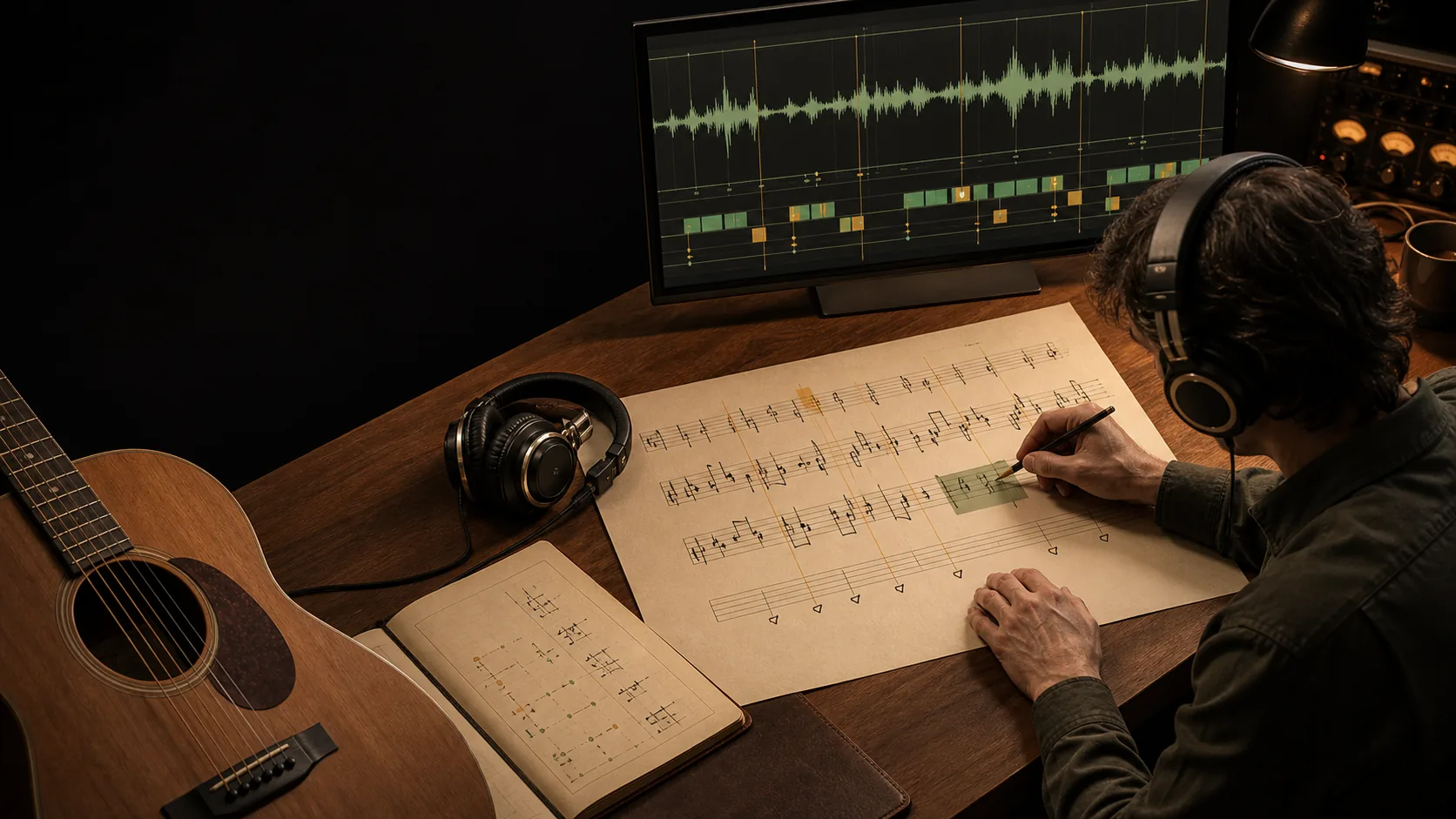
What this page provides
A reproducible measurement contract that distinguishes model research results, pipeline tests, musician review and the behavior of the exact app release.
What this page does not provide
A fabricated percentage, a claim that every detected chord is correct or a benchmark number borrowed from a paper and relabeled as Guitar Mentor performance.
At a glance
| Dimension | Measure | Question answered |
|---|---|---|
| Label accuracy | Duration-weighted chord symbol recall at declared vocabularies | Are the predicted roots and qualities correct over time? |
| Boundary accuracy | Onset and change-time deviation | Do labels change near the audible harmonic change? |
| Segmentation | Over- and under-segmentation | Is the chart jittery, or does it miss real changes? |
| Coverage | Failure, timeout and no-result rates | How often does analysis produce a usable chart? |
| Robustness | Per-slice results | How does it handle live audio, distortion, inversions and key changes? |
| Practice utility | Blinded musician task review | Can a guitarist use the chart to enter, loop and play the song? |
Why one accuracy number is not enough
Automatic chord estimation maps continuous audio to symbolic labels and time intervals. There is no single universally correct comparison because a complex reference chord can be reduced in several musically meaningful ways. A system may get the root right but the quality wrong, or identify the right sequence with late boundaries.
The open-source mir_eval project therefore implements several comparison vocabularies, including root, major/minor, triads, sevenths and richer relationships. MIREX describes chord symbol recall as the duration of correctly overlapping labels divided by annotated duration, then weights results across songs to produce WCSR.
The minimum defensible dataset
A useful product benchmark should use rights-cleared audio with time-aligned reference annotations reviewed by musicians. It should not contain only clean studio pop. We would stratify the corpus across:
- clear major and minor triads;
- sevenths, suspensions, extensions and inversions;
- pedal bass and slash-chord movement;
- distorted guitars and dense arrangements;
- live recordings, room noise and crowd noise;
- capo, detuning and alternate tuning;
- key changes, short transitions and no-chord regions;
- music from several regions, eras and production styles.
Two annotators should work independently, then adjudicate disagreements without seeing the model output. The test split must be separated from model training and tuning data.
Metrics we would publish
Duration-weighted chord recall
Report root, major/minor, triad and seventh vocabularies separately. State exactly how “no chord” and unscorable labels are handled. Report a corpus aggregate and per-song distribution rather than only the best average.
Boundary and segmentation behavior
Measure how far predicted change points are from the references, and publish over- and under-segmentation. A chart that flashes several short false changes can have a tolerable label score while being unpleasant to play.
Operational coverage
Include import failures, timeouts, fallbacks and empty results. Accuracy on the subset that survived processing is incomplete product evidence.
Practice usefulness
Ask blinded guitarists to complete defined tasks: find the opening chord, enter at the chorus, loop a progression and accompany the recording. Record corrections required and time to a playable chart. This is a separate human-use metric, not a replacement for WCSR.
What Guitar Mentor tests today
Guitar Mentor’s current pipeline uses a BTC-family chord recognizer, then aligns and merges results for the song player. Automated tests cover output shape, label normalization, beat snapping, fallback behavior and recorded “golden” wiring through the analysis path.
Those tests are valuable engineering evidence: they catch broken integration and inconsistent results. They are not a complete musical benchmark. A mocked happy-path test does not prove chord accuracy, and one known song does not represent real-world repertoire.
How to read any app’s accuracy claim
- Ask whether the number measures a research model or the shipped product.
- Check the chord vocabulary. Major/minor is easier than rich chord qualities.
- Check whether timing is duration-weighted.
- Look for dataset names, licensing, version and a held-out test protocol.
- Look for failures and difficult-song slices, not only an average.
- Confirm that a musician reviewed practical chart usability.
If those details are missing, treat the percentage as marketing rather than reproducible evidence.
Our publication commitment
When Guitar Mentor publishes a numeric accuracy result, this page should be updated with the corpus version, annotation process, metric code, model and app build identifiers, aggregate results, per-slice results, coverage failures and known limitations. Until that package exists, the honest statement is simpler: automatic chords are a useful starting point that must be checked by ear.
Frequently asked questions
What is WCSR?
Weighted chord symbol recall measures the duration for which estimated chord labels match reference labels, with song-level results weighted by duration when aggregated across a corpus.
Why can two accuracy numbers differ?
They may use different chord vocabularies, datasets, timing methods, handling of no-chord regions or model versions. A major/minor score is not directly comparable with a large-vocabulary score.
Does Guitar Mentor publish an accuracy percentage?
Not for the complete exact live pipeline at corpus level as of August 21, 2026. We intentionally avoid borrowing a research number and presenting it as an app benchmark.
How should a guitarist verify generated chords?
Slow the recording, listen to the bass, compare repeated sections, test the chord against sustained notes and ask another musician to review material intended for performance or publication.
Sources and review date
Checked August 21, 2026. Product features and limits can change after publication.
Turn a song into a focused session.
Try Guitar Mentor free, then decide from your own playing whether the workflow fits.
Android is currently offered as a signed direct APK because the public Google Play URL did not resolve when this article was checked.